 Aperture
live wormhole mapping for EVE Online
The wormhole map your corp shares, that keeps itself up to date.
Collaborative live wormhole mapping for EVE Online. Sigs paste straight in, tracked pilots move on the map as they jump, and every edit lands on your corpmates' screens the moment it commits. Open source, MIT licensed, self-hosted with one command.
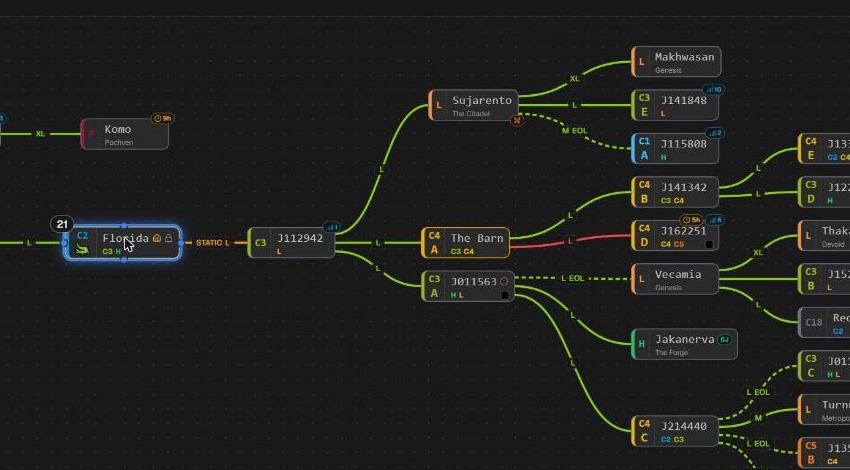
the shared map
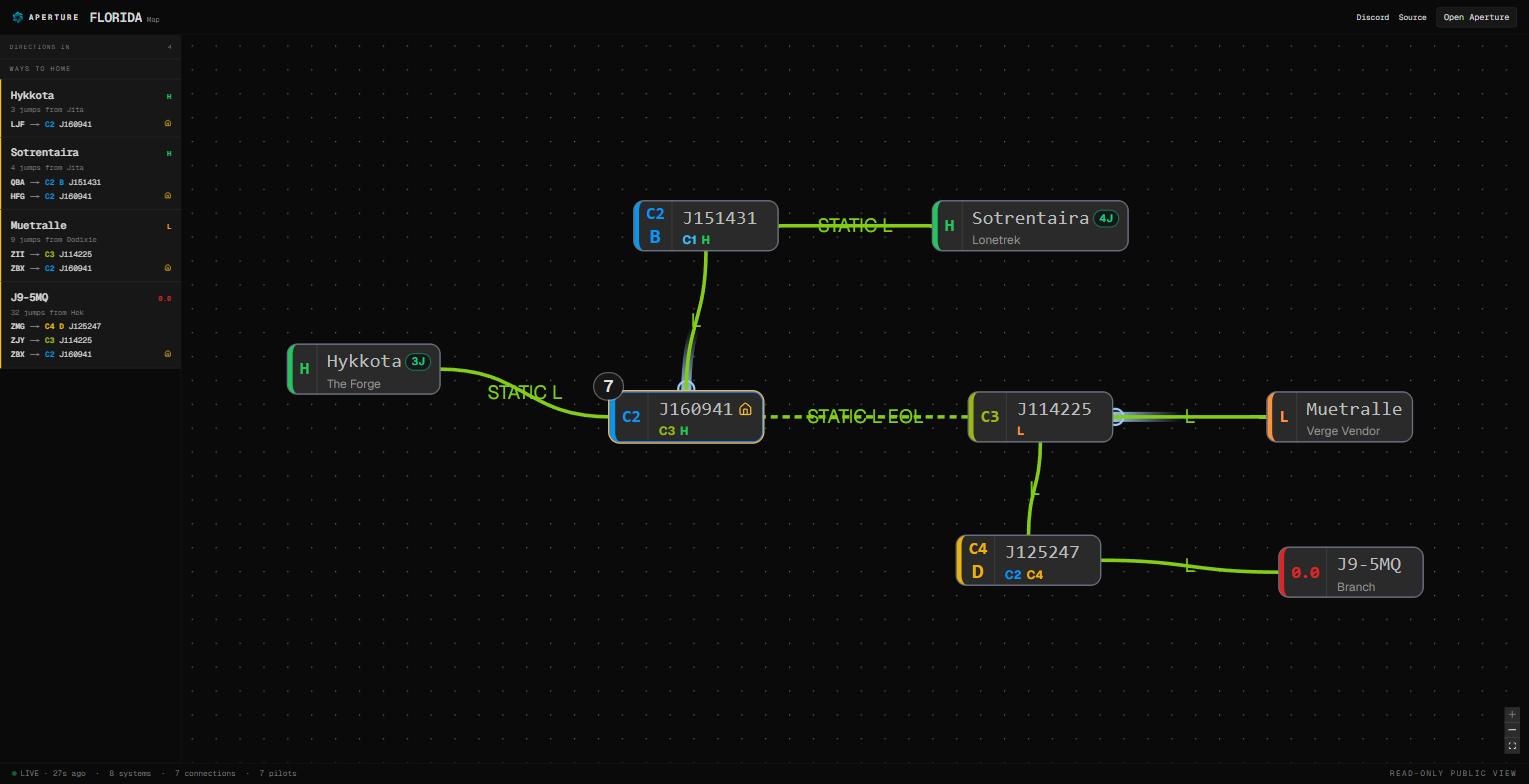
Every edit lands on everyone's map
Two or twenty corpmates can work the same chain at once. Every system, connection, signature and note edit fans out over a WebSocket the moment it commits: no refresh, no polling, no asking who has the latest map.
If realtime ever falls behind, a banner says so rather than letting the map go quietly stale. And after a deploy, a tab you are looking at offers a Reload button instead of pulling a half-typed intel note out from under you.
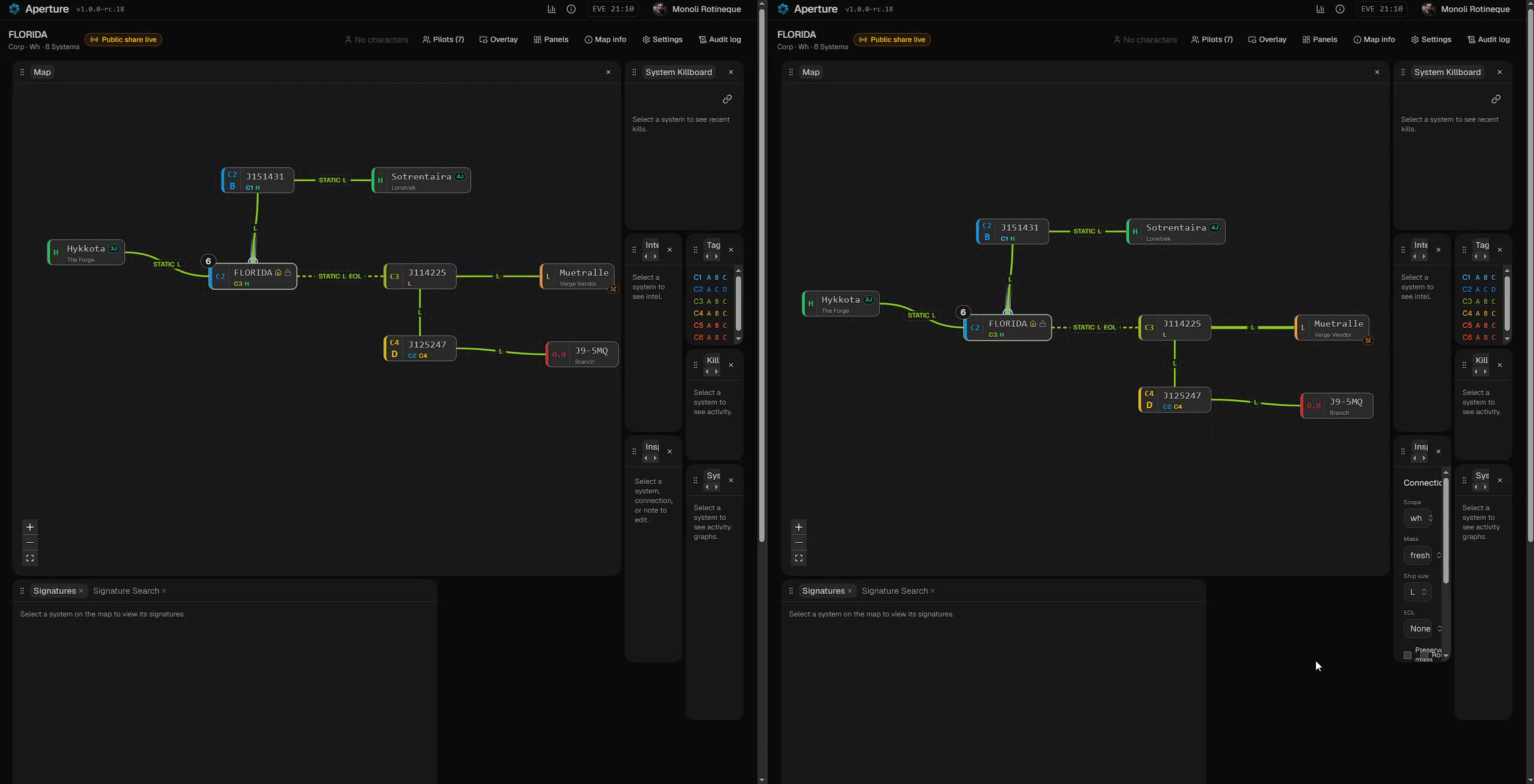
the pilot roster
Tracking runs on the server
Location polling is a background job on the server, one per tracked character, so jumps appear on the map whether or not anyone has a browser tab open. A new system is placed in an open slot next to the one it was reached from and the connection draws itself, so the chain grows in a readable shape without dragging.
Every tracked pilot carries a ship-class icon for the hull they are in, so fleet composition reads at a glance. One account holds every alt: link your characters once and fly the whole map from a single tab.
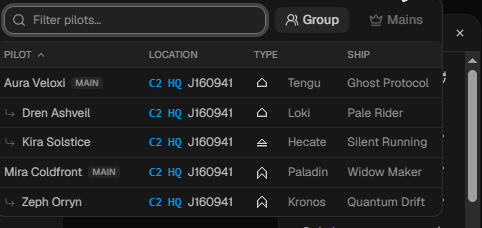
the signature table
Sigs paste straight in
Paste the probe scanner dump and Aperture resolves signature groups and wormhole types, links connections automatically, and ages sigs out after 48 hours, the longest a hole can stay open. Each row carries a combat-versus-exploration read, red swords or a green shield, so a scout can tell whether a site will shoot back before warping to it.
Signature search covers every system on the map at once: filter by wormhole class or k-space security, anomaly versus signature, or a single Shattered toggle, and click a result to snap to the system carrying it. D-Scan pastes into a sortable table for diffing against an overlay.

the chain
It knows what a wormhole is
Hover any connection for its type, size class, leads-to, total stable mass, max jump mass, lifetime and a live EOL countdown. Jump mass is logged automatically from observed jumps by tracked pilots, not typed in by hand, so the mass figure is a record rather than a guess.
Either mouth of a hole can be flagged bubbled on its own, EOL runs through stages to expired, and multiple holes leaving one face of a system fan out so they never cross. Fixed-destination holes, J377 to Turnur or the C12s to Thera, resolve onto the map in one click with no far-side scout.

the panel grid
Panels arrange the way your corp works
The dashboard is a draggable, resizable grid. Drop one panel onto another to stack them as tabs, pull a tab out to split it into its own cell, and keep a separate layout per breakpoint. A layout exports to a JSON file, so a corp can standardise one and hand it round.
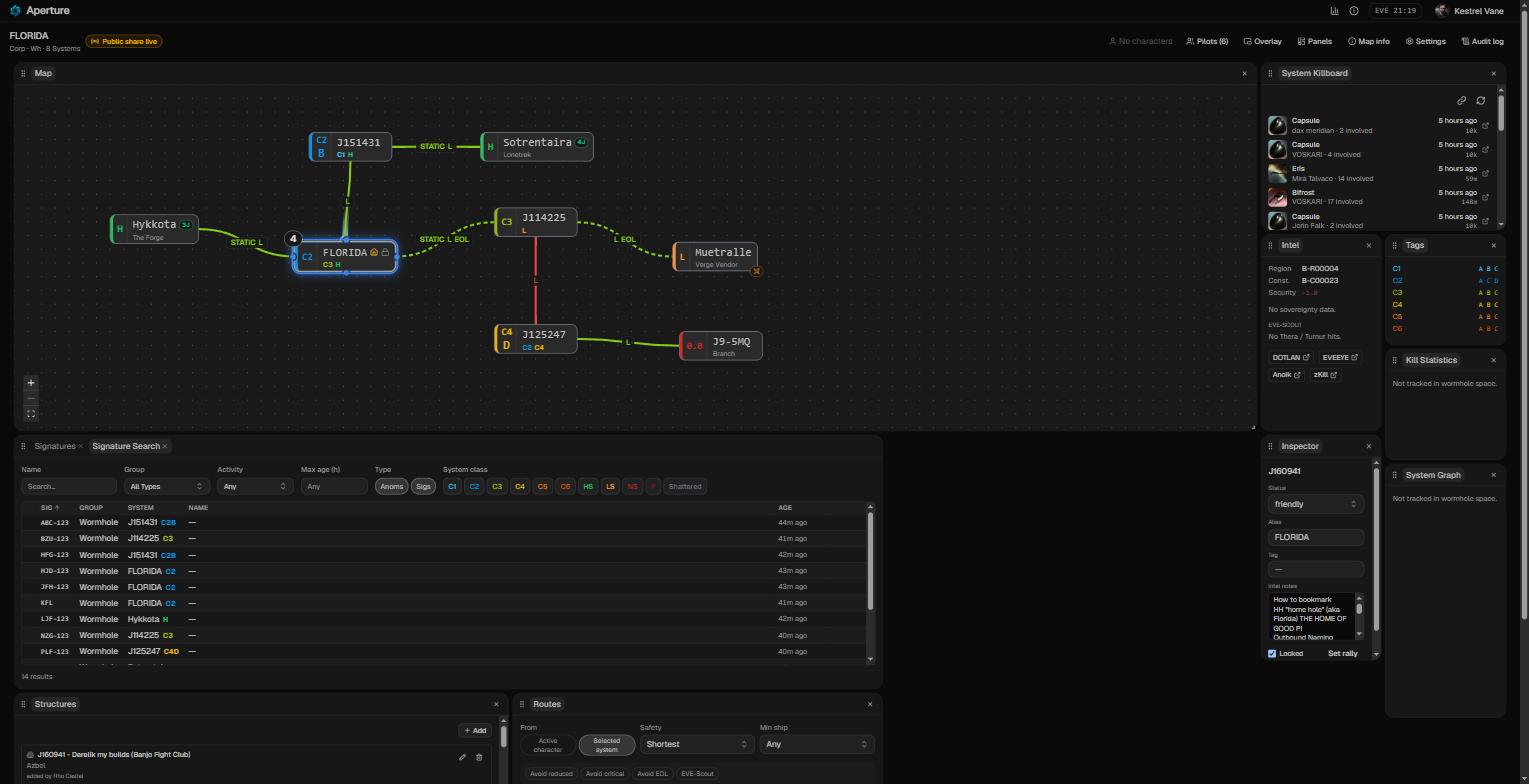
the spectator view
Share the chain, keep the accounts
Managers can mint an unguessable link that shows the map live to anyone holding it, no login involved. Spectators get the chain plus a directions-in board: every k-space way in, the sig to scan, and the jumps from the nearest hub. Publishing signatures and bubble flags is opt in, per link, off by default.
Handy for a coalition op, an open event, or a live route posted into a public Discord without handing over an account.
latest releasev1.1.021 September 2026
Built in the open
Aperture began as a ground-up rebuild of Pathfinder and shares none of its code: the same idea, built again on a current stack. It ships roughly weekly, and every release carries a written changelog. That dated list is a better picture of the project's health than anything this page could claim, so read the changelog.
- MIT licensed
- The source is on GitHub. Fork it, audit it, run it however you like.
- Current with the game
- A daily job checks FC's published static data and ingests new builds on its own. New ships and systems appear after a patch with nothing to run.
- One container, one database
- A single Node process runs the app, the WebSocket server and the background worker, against Postgres. No Redis.
- In production today
- Runs live for an EVE alliance right now.
- Accountable by design
- Directors get management rights from EVE itself, membership changes are enforced automatically, and every map edit lands in a browsable audit log.
- More than one pair of hands
- Multiple contributors, credited by character name in every release.
Two ways to run it
Fly on the public instance
app.aperturemap.com is open to everyone. Sign in with EVE SSO and create a map, or, as a corp Director, create one for your corp or alliance. It is community-run, with no uptime promise; the instance page spells out the terms.
Open the public instanceSelf-host for your corp
One docker compose up -d brings up the app, its migrations and Postgres. Login is restricted by allowlist, and your corp's data stays on your own box.
Questions, feature requests or bugs: the Aperture Discord is the front door, and contributions are welcome through the repo.